
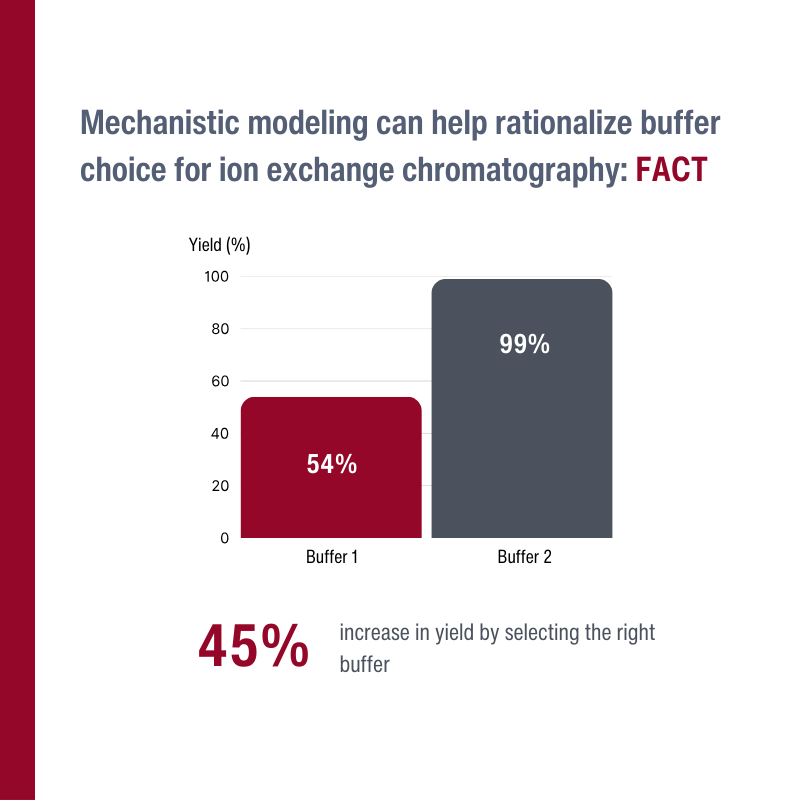
The proper selection of buffers is essential in the design of ion exchange processes. It was reported that at a given pH and ionic strength, a change in the type of buffer (e.g., acetate to phosphate) may have a dramatic impact on protein separation.
This study aims at assessing whether mechanistic simulation can predict the impact of the buffer type on the separation of two proteins and thus serve as a tool to perform numerical screening and reduce the experimental burden.
Take home messages
- A pH gradient may be observed at the column outlet even if the pH is kept constant at the inlet!
- Two buffers of the same pH and ionic strength may behave very differently – the buffer type plays a key role.
- The proper selection of buffers is essential in process design to ensure protein separation.
- Predictive simulation can be used as a tool for buffer selection, reducing the experimental burden.
Explore our additional case studies
- Prediction of the impact of buffer type: Application to protein purification by IEX chromatography
- Comparison of single column and MCSGP processes: Application to oligonucleotides purification by ion exchange chromatography
- Design of a multicolumn process for mAb capture: Impact of the number of columns on key performance indicators
- Prediction of an oligonucleotide purification by IEX: Impact of key operating parameters in a complex process