
Full Process View
Common problems
Our solutions provide a unified process view, revealing how each operation impacts yield, sustainability, and efficiency
Upstream and downstream steps are often developed separately, which makes it difficult to evaluate the overall impact of process decisions. Typical challenges include:

Our solutions
Software Solutions
Proxima® Suite
Collaborative partnership - Extended team
Leverage the wealth of experience at Ypso-Facto and exploit our unique approach to streamline your process development and confidently secure your process. Our consultants are equipped with cutting edge tools and ready to help!
Custom software development
We have significant experience in developing scientific software tools for specific needs. These custom tools benefit from the solid foundations of our own software platform.
Case studies
Process: Multi-step process for nutraceutical production from Krill oil
Product: Omega-3 fatty acid rich nutraceuticals
Challenge: Addressing the complexity of a nutraceutical production process with variable raw material composition and numerous unit operations requires developing a clear, detailed factory representation to enable mass balance calculations and identify performance bottlenecks.
Achievements:
To address the complexity of a process using raw material from a natural source with variable composition and numerous unit operations, a clear representation of the entire factory was developed. The process was modeled with a gradual increase in detail: starting from a single block, then seven blocks, and finally around fifty blocks to capture all critical steps.
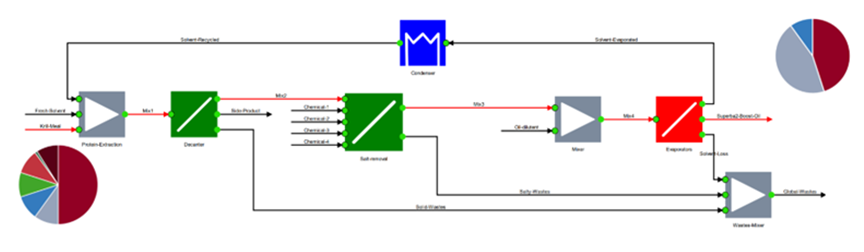
Fig. 1: Representation of the Nutraceutical production process (Screenshot from Basic®).
This detailed representation enabled the calculation of a complete mass balance across the factory and identification of bottlenecks limiting performance. Based on these insights, the process was modified to achieve a 20% increase in yield.
Key message: Progressive modeling of complex processes provides clarity, reveals hidden bottlenecks, and supports significant performance improvements.
Process: Converging synthesis of a small molecule API
Product: Active Pharmaceutical Ingredient
Results: To perform an 8-step converging synthesis in an existing multipurpose workshop, quick access to a bill of materials and feasibility checks were essential. Using our software, the complete bill of materials was generated quickly and exported to Excel for easy review.
The process was visualized in more detail in an equipment diagram, focusing on two critical chemical steps (alkylation and arylation) with clear representation of filling levels. This allowed identification of capacity constraints and planning of retro-fit operations.
Several liquid–liquid extractions and filtrations were adapted by splitting operations into smaller batches to fit existing equipment, ensuring compliance without major investment.
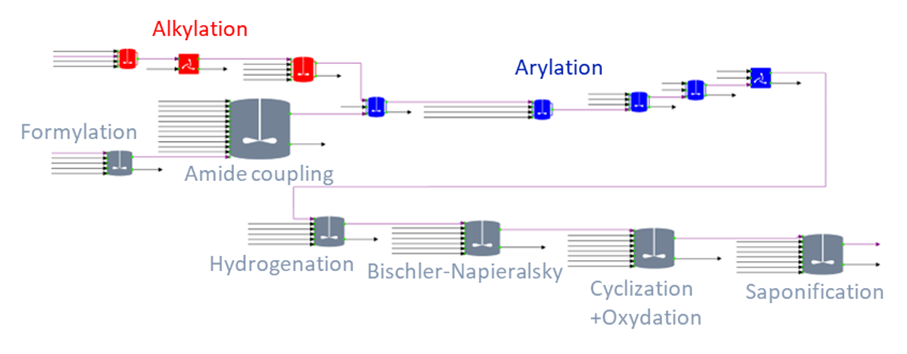
Key message: Digital process representation combined with equipment feasibility checks enables rapid decision-making and efficient adaptation of complex syntheses in multipurpose facilities.
Your questions, answered
Yes. Proxima® allows you to model upstream and downstream steps together, providing a unified view of mass and heat balances, costs, and performance indicators.
Basic is used to build flowsheets and visualize the process. Eval calculates technical, economic, and environmental metrics for scenario comparison. Multistep supports detailed input of complex synthesis sequences and subsequent evaluation of trade-offs between strategies.
No. The tools are designed to work with limited data at early stages. As more information becomes available, models can be refined for greater accuracy.
Yes. It is ideal for scenario analyses to help you identify the best process configuration in terms of cost, productivity, and footprint.
Yes. Proxima® supports custom cost data to ensure evaluations align with your internal benchmarks.
Faster decision-making, improved collaboration across teams, and the ability to identify true performance levers early in development.
What about your molecule?
Whether we have already worked or not on the type of molecule you are interested in, we hope that the numerous examples above show that we are able to work in a wide variety of fields and in a wide variety of processes. Why not on the process for the production of your molecule? Contact us now to get to know more how we can help you.
Want to know more?
Don't hesitate to contact us!