
Downstream processing
Common problems
We simplify DSP in Tides production with model-driven solutions ensuring purity, yield, and stability
Downstream processing faces multiple issues that need to be resolved to guarantee that the target product is produced within specification, in a reproducible way and at the desired throughput.

Learn more about Ypso-Ionic®
Our solutions
Software license
Ypso-Ionic® was designed to speed up the development, optimization and scale-up of chromatographic processes. It combines 3 main functionalities, which can also be purchased independently:
SUPPORT PACKAGES
Our experts provide step by step guidance
from building a model with you to running simulations for you with the Essential,
Advanced and Comprehensive packages.
Collaborative partnership - Extended team
Our team delivers comprehensive downstream process development services, while working alongside your scientists and engineers to challenge assumptions and strengthen internal initiatives. We bring clarity to complex processes by structuring data from diverse sources, testing scenarios with our models, and identifying key process levers.
Typical project goals include:
By combining the expertise of our process specialists with powerful in-house software tools, we help you make faster, more confident decisions. Choose the level of support to complement your project:
EXPLORE, to get started with confidence: Set-up a first mechanistic model calibrated by Ypso-Facto's specialists and demonstrate its benefits on a concrete case study.
EXPAND, to widen tool capabilities: Take more physical phenomena into account, get more accurate predictions.
EXPLOIT, to support decision making: Capitalize on the obtained model to solve a real industrial challenge (e.g., reduce impurity content, improve yield, support filing, secure scale-up)
Custom software development
We have significant experience in developing scientific software tools for specific needs. These custom tools benefit from the solid foundations of our own software platform.
Furthermore, we offer a variety of web tools relying on the Ionic calculation engine to simulate specific processes with a user interface resembling the one of the machine, hiding all the details related to the model. Such tools are particularly useful for training purposes and assess process robustness.
Case studies
Process: Strong anion exchange with phosphate buffers containing NaCl or NaBr
Product: Oligonucleotide
Results: During a purification of an oligonucleotide with strong anion exchange chromatography, a drastic, unexpected pH drop was observed. This puzzled the experimenters who suspected a malfunction of the chromatography equipment.
As part of the investigations, blank experiments were performed with a protocol identical to that used for full purification experiments, except the crude solution was replaced by the solution matrix, i.e. excluding the oligonucleotide.
Results for the blank experiment performed with sodium chloride (NaCl) are shown in Fig. 1. Vertical lines indicate process steps for (1) regeneration, (2) equilibration, (3) loading, (4) wash, (5) elution gradient, and (6) regeneration.
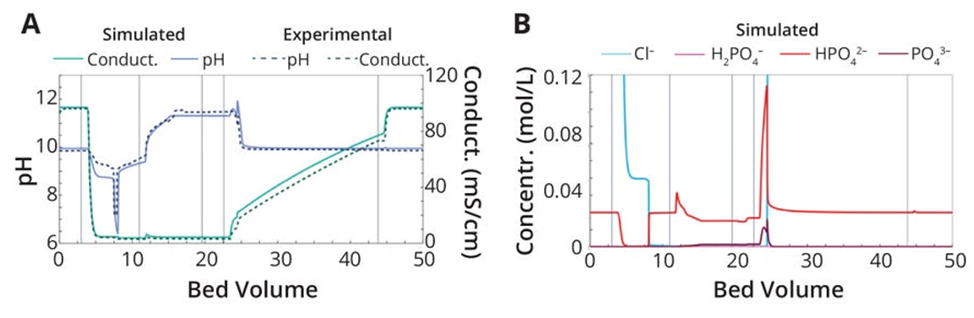
Fig. 1
In Fig. 1A pH and conductivity profiles of the entire run are shown. A peculiar negative pH spike at around 8 bed volumes is immediately apparent, while the inlet pH is constant at pH 10. .
Modeling and simulation then brought clarity: As indicated by the measured (dotted lines) and predicted (solid lines) conductivity and pH profiles, the pH spike is a feature of the investigated buffer-resin system. Looking at Fig. 1B, the simulated ion concentrations indicate that the negative pH spike is caused by sharp concentration changes of Cl- and HPO42- ions.
Key message: Ypso-Ionic® is able to simulate peculiar pH profiles and can be used to rationalize unexpected behaviors.
Process: Strong anion exchange with NaCl gradient
Product: Oligonucleotide
Results: Using a number of well-thought experiments, a predictive mechanistic model for the purification of an oligonucleotide was developed. Comparing experimental and simulated elution profiles (Fig . 1), it is seen that the model is capable of predicting the chromatograms that are obtained in a pH range between 8 and 12 and by switching from NaCl to NaBr as eluting salt. The simulation of the peak shapes and positions is remarkably precise, comforting the applicability of the model to simulate untested operating conditions.
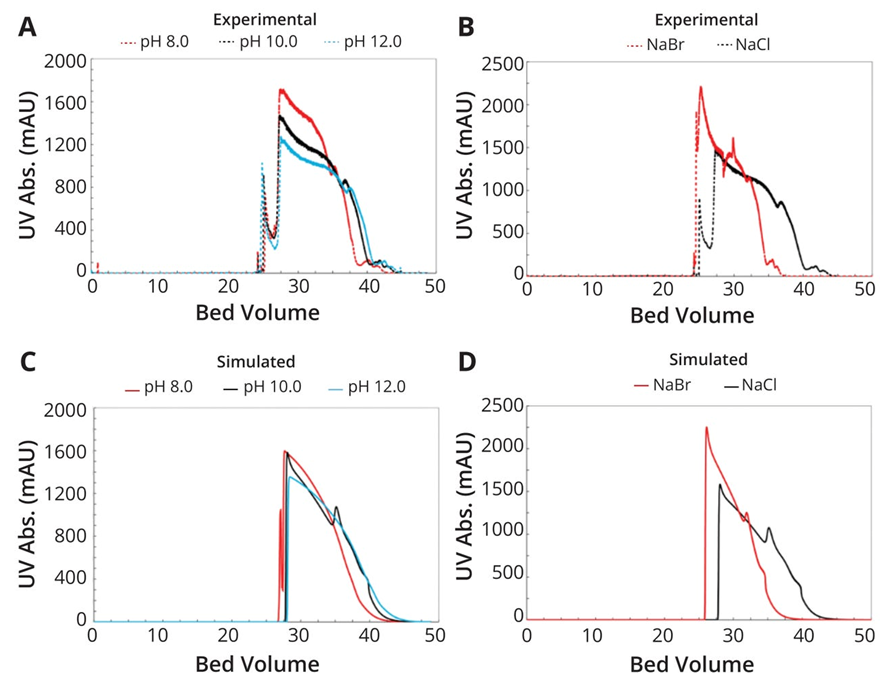
Fig. 1
The model was then used to assess a range of operating conditions and key performance indicators as yield and PMI were calculated from the simulated chromatograms. Starting from only a handful of experimental points a huge virtual space can be assessed in silico, from which optimal process operating conditions can be identified (Fig. 2).
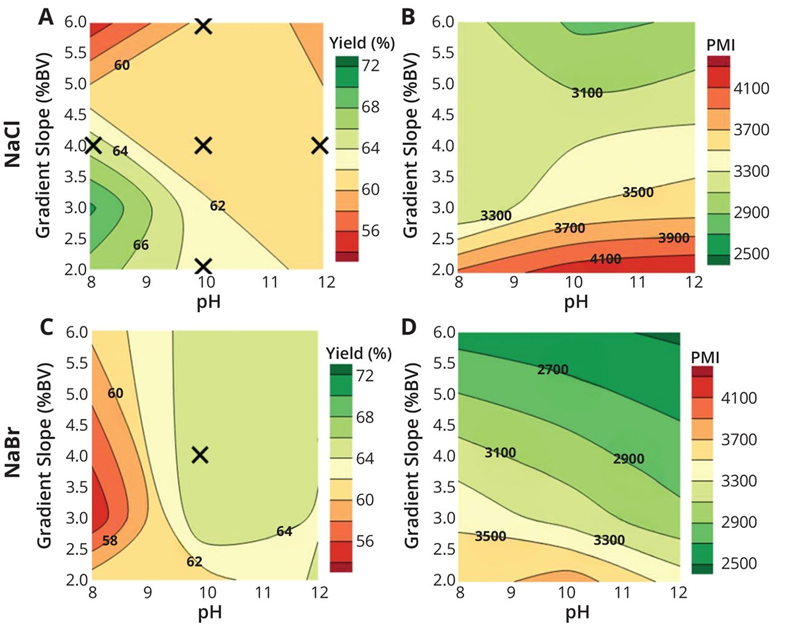
Fig. 2
This enables tremendous savings of material and time that otherwise ought to be spent in the lab or analyzing the generated experimental data.
Key message: By exploiting mechanistic modeling, many operating conditions can be investigated to ensure the best possible purification with less experiments.
Your questions, answered
By capturing the true physics and chemistry of chromatography, our tools predict separation performance, impurity clearance, and help you find optimal operating conditions. This enables you to design robust, high‑yield purifications with fewer experiments.
Ionic can predict the impact of numerous process parameters including (but not limited to): product concentration in the crude solution, impurity concentration in the crude solution, loading volume, flow rates, salt concentration, salt type, buffer concentration, buffer type, gradient slope.
Absolutely! Unlike statistical models which are based on correlations and are only valid for their calibration data set, mechanistic model parameters have an actual physical meaning and can be applied to different process setups and process scales. This gives you confidence in scaling up your chromatography processes by changing column dimensions and even enables you to adapt the operating sequence if needed. Mechanistic modeling can also help with troubleshooting. If the scaled-up process isn’t performing as expected, you can test potential reasons via simulation and take appropriate action based on the results.
Yes. Built-in models for ion exchange, hydrophobic interaction, and reverse phase chromatography, which are commonly used for TIDES purification, are standard in Ionic. Other chromatography modes like normal phase, affinity and even complexing resins can also be simulated.
Usually, one particular mode of interaction between the target molecule and the stationary phase is dominant and it is sufficient to model that. Also, the built-in models generally have a sufficiently large scope to cover most purifications. Should this not be the case, we have the possibility to create user models considering specific and multiple (e.g. mixed mode) interactions.
Definitively! We offer several levels of support, ranging from essential to comprehensive, where process experts perform the modeling work for you so that at the end you have a ready-to-use model in your hands.
Often only a small set of targeted experiments is needed to parameterize a first reliable model. We guide you in collecting the minimal dataset required to achieve actionable results quickly. The exact number depends on the targeted precision, but typically around 15 experiments, of which only a handful are full purification experiments, are sufficient to build a model. Read more about our proposed methodology in an OPRD article (link to https://www.ypsofacto.com/publication-post/27-Oligonucleotide-Purification-by-Ion-Exchange-Chromatography-Step-by-Step-Guide-to-Process-Understanding-Modeling-and-Simulation).
While it is true that you need to perform some experiments for each new target molecule to feed data to the model, the more you do mechanistic modeling, the better it gets. Actually, a platform approach is particularly suited to mechanistic modeling, as some of the chromatographic media, buffer solutions and equipment pieces will likely be used for several target molecules. Only part of the overall experiments involve the use of the actual target molecule. Characterization of the solid phase, buffer solutions and equipment pieces only needs to be done once and can be re-used for another target molecule. Only those experiments needed to characterize the specific target molecule in solution and its interactions with the solid phase are required to be performed each time you have a new molecule.
Yes. Any kind of multicolumn chromatography process with any number of columns and configuration (e.g. MCSGP) can be simulated to help you increase productivity, reduce resin costs, and shorten cycle times before making hardware changes.
Yes. We support data import from common chromatography equipment and offer interoperability options that fit seamlessly into your digital workflow. If a direct import from the equipment is not possible, csv or Excel import can be used or a custom import could be tailored to your specific equipment.
It strongly depends on the complexity of the model and of the simulated process. Generally, most simulations are done in a range of a few seconds to a few minutes on common office laptops. Very complex and demanding processes may take a few hours to compute, but this is rare and still faster and less expensive than setting up, running and analyzing an experiment.
Yes. We will evaluate with you your actual collaboration needs and work with your IT department how to best integrate our software into your existing IT infrastructure.
Yes. We will evaluate with you your actual needs and work with your IT department how to best integrate our software into your existing IT infrastructure. Integration may be achieved through several ways: for example, by using standard data exchange formats like txt, csv, Word and Excel or by tailoring custom imports/exports to communicate with the other apps of your workflow.
Clients have reported up to four times fewer experiments, more than fifty percent solvent reductions, and doubled productivity in certain chromatography steps. These improvements lead to faster development, lower costs, and greener processes.
Yes. Mechanistic models are based on first principles and offer full transparency and explainability. Their assumptions, equations, and parameters are explicitly defined, allowing for established validation procedures. For a given input and set of model parameters, such models will always reliably provide the same output. This makes them suitable for regulatory purposes. The level of details regarding the model description in the dossier is dependent on the intended use of the model, its role in the control strategy and the risk to material quality.
Want to know more?
Don't hesitate to contact us!