Full Process View
Common problems
We provide rapid, transparent scenario comparisons that clarify cost drivers and connect synthesis to purification decisions
In the rapidly evolving oligonucleotide and peptide market, organizations must quickly assess the technical and economic feasibility of manufacturing target molecules, often before sufficient process data is available. To address this, teams often develop flexible, spreadsheet-based tools that operate with minimal input data and provide rapid, preliminary assessments. However, these tools are typically created and maintained independently within different departments or teams. As a result:
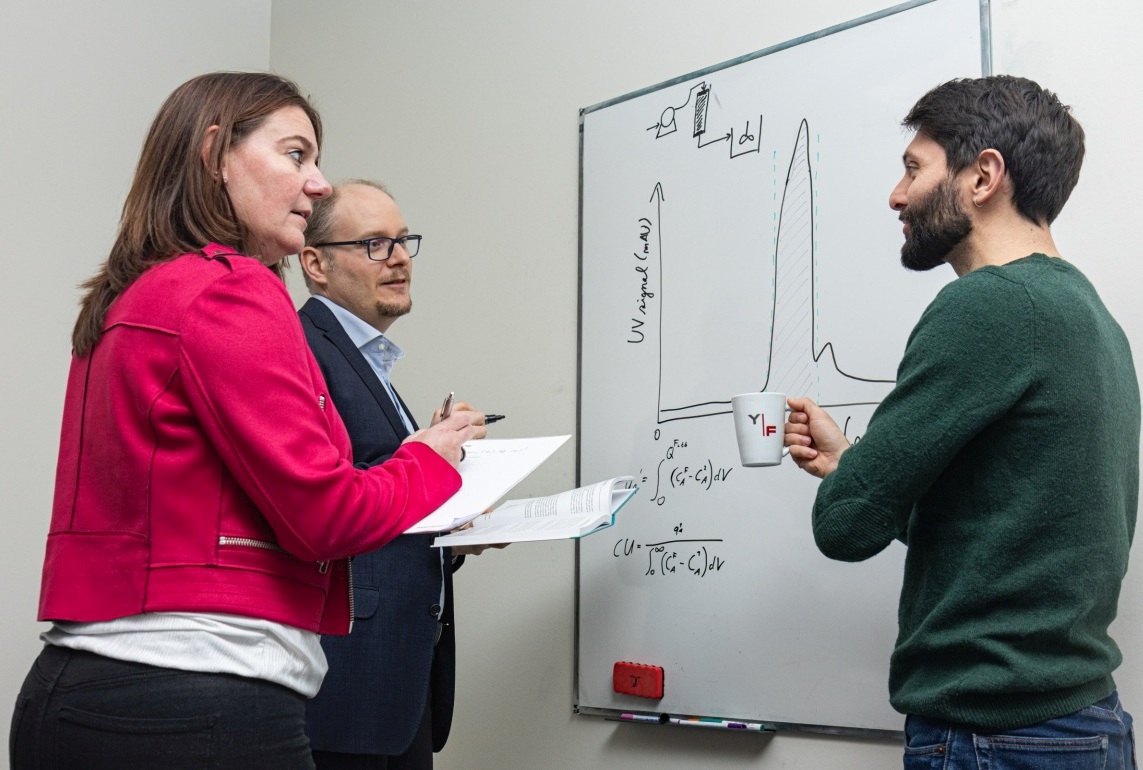

Besides, while upstream and downstream steps are often developed and optimized individually by different teams, decision-makers face persistent challenges when considering the entire bioprocess. Yet it is crucial to analyze all unit operations together to identify true performance levers.
With the appropriate level of modeling, several key challenges can be addressed around process intensification, sustainability and cost optimization such as:
Our solutions
Software license - Basic Design & Eval
With a license for the Basic Design and Eval apps of the Proxima® suite, your teams can directly model
complete bioprocesses. Basic Design provides flowsheet representations as well as mass
and heat balances, while Eval translates them into economic and environmental
metrics such as PMI, E-Factor of CO2 equivalents.
These apps rely on simplified yet powerful process descriptions, making them accessible to engineers without
specialized modeling expertise.
This mode is ideal if you want to build in-house capability and maintain full control over analyses. We can also provide support packages with a level of support adapted to your needs to help you get on track faster.
Collaborative partnership - Extended team
We work alongside your scientists and engineers, challenging assumptions and complementing internal initiatives. Acting as an extension of your team, we bring clarity by structuring data from diverse sources, testing scenarios, and identifying the most relevant process levers. This approach accelerates adoption and ensures results are aligned with your development strategy.
Independant assessement - External advice
If preferred, you can simply share process data and scenarios with us. Ypso-Facto will then deliver an agnostic, third-party evaluation using Basic and Eval. This provides clear, unbiased answers to specific questions, for example, whether a switch to a continuous chromatography system or single use technologies are adapted to your needs and constraints.
Your questions, answered
Yes. We can integrate SPPS or SPOS synthesis, work‑up, and downstream purification into a single flowsheet that provides mass balances, cost analysis, and sustainability metrics.
Yes. There is no limitation in terms of processes – may it be batch, continuous or a combination of both.
Proxima®’s Basic Design module allows users to create high-level and detailed process diagrams using functional blocks and equipment types. This supports mass and heat balance calculations across the entire process from upstream, downstream, and auxiliary steps, providing a unified view for all stakeholders. Flowsheets, mass balances and cost evaluations can be refined iteratively over the lifecycle of the process.
Yes. Proxima® supports the integration of your own cost data, allowing you to tailor economic evaluations to your specific context. This ensures accurate cost-of-goods calculations and standardized comparisons across projects and teams.
Want to know more?
Don't hesitate to contact us!