
Downstream processing
Discover Ionic software below
Ypso-Ionic®
A powerful solution for chromatography process development. Harness Ypso-Ionic’s cutting-edge engine to simulate chromatography processes in various operating parameters. Achieve optimal process conditions with fewer experiments than traditional OFAT or DoE approaches.
Take a look inside YPSO-IONIC:
Ionic’s interface
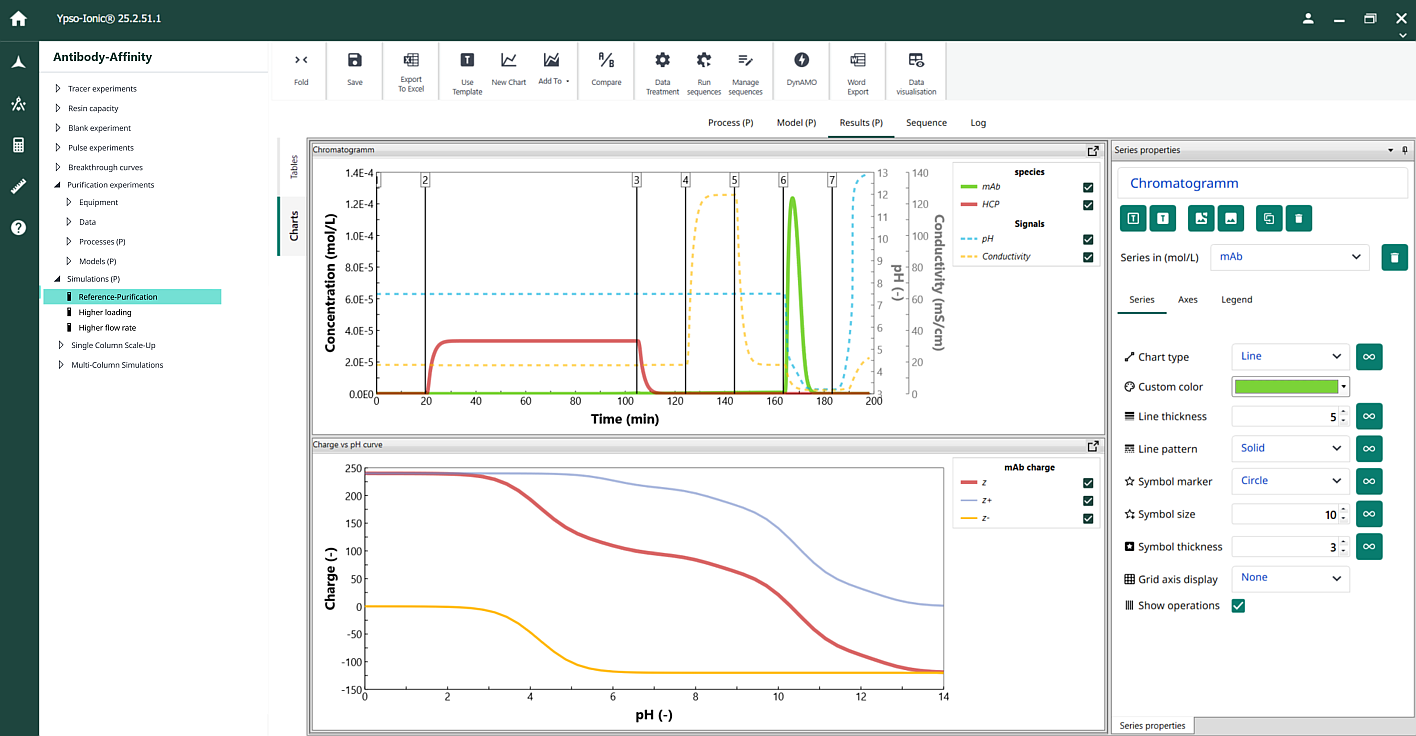
A clearly structured arborescence provides fast and easy navigation through your project
At any moment you can select your preferred units
Various built-in data treatments facilitate daily data analysis tasks:
- Generation of fractions from continuous data
- Calculation of key performance indicators like purity and yield
- Mass/mol conversions
- Time/Volume/BV conversions
- and more…
Automatic sequencing of multiple data treatments speeds up your work
Powerful graphing tools allow displaying process steps on the curves. Charts can be fully customized and quickly formatted using custom templates.
All tabular results can be exported to Excel.
A quick Word report is generated by exporting detailed process descriptions accompanied by charts.
Navigate through clear visuals and an intuitive interface to accelerate your chromatography development. Unlock the full potential of Ionic’s extensive features and maximise insights from your data.
Adaptable to your process
With downstream scientists and modellers in mind, Ypso-Ionic is equipped with a plethora of features, from defining process flows to fine-tuning model parameter granularity. The platform was built to adapt to your project needs.
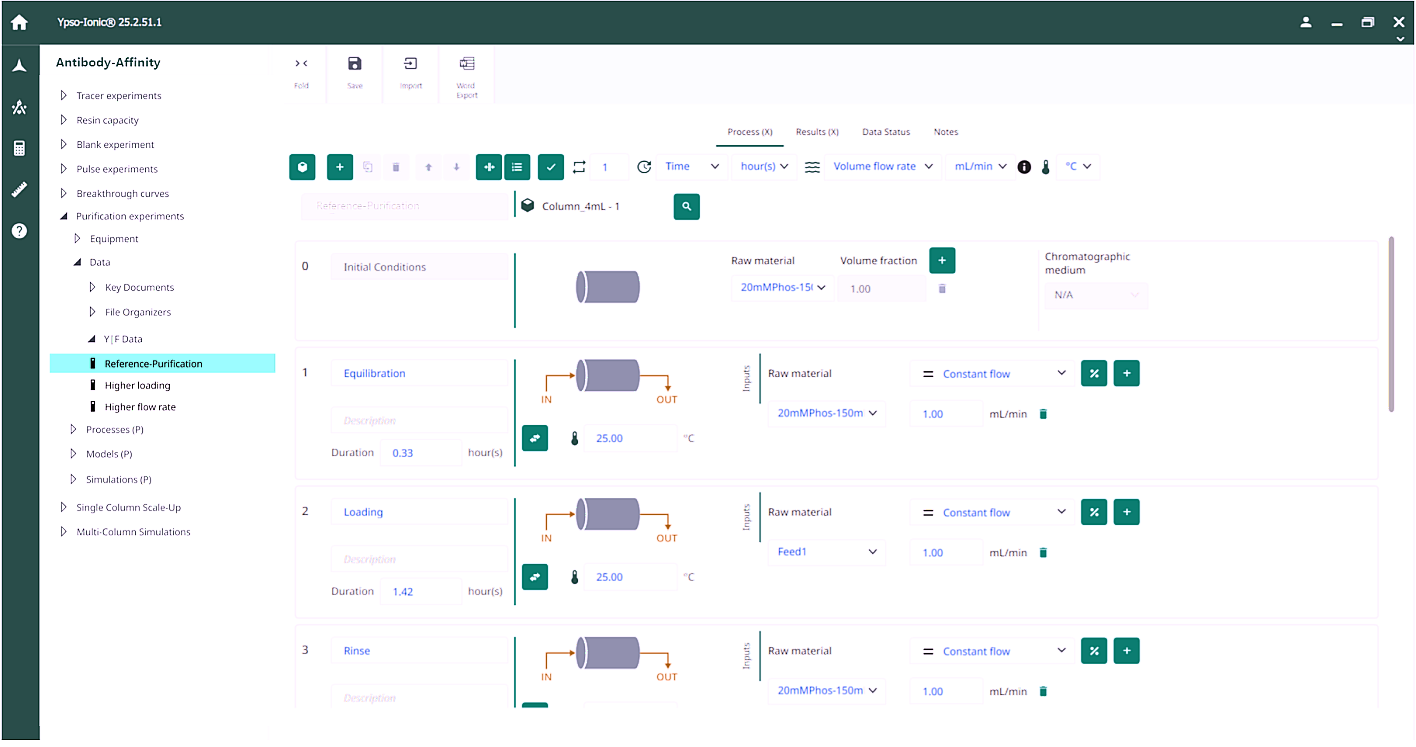
The process description is stored alongside the gathered experimental data.
All data, both online and offline, is structured in tables, clearly labelled and stored with units.
Initial conditions are specified
Steps names, durations and many details can be configured. Multiple columns, dead volumes and collection tanks can be added in any number and connected without any restrictions.
Advanced flow configurations like gradient flows are available
Backflush is possible
Information entered elsewhere, like column dimensions and raw materials composition, can be easily consulted
Built-in automatic checks help you detect and troubleshoot any issues with your process setup
Display units can be changed on-the-fly to adapt to your momentary needs
Notes and comments are stored with your data.
Model fundamentals of Ypso-Ionic
Current approaches to modelling chromatography processes often rely on simplified empirical correlations or purely data-driven models. Though useful for fitting historical data and extrapolating trends, such methods typically lack robustness and predictive power.
Ypso-Ionic is a powerful mechanistic modelling tool based on first principles, allowing users to accurately simulate chromatographic processes. Ypso-Ionic accounts for four complementary physico-chemical foundations to deliver reliable, predictive simulations:
- Kinetics
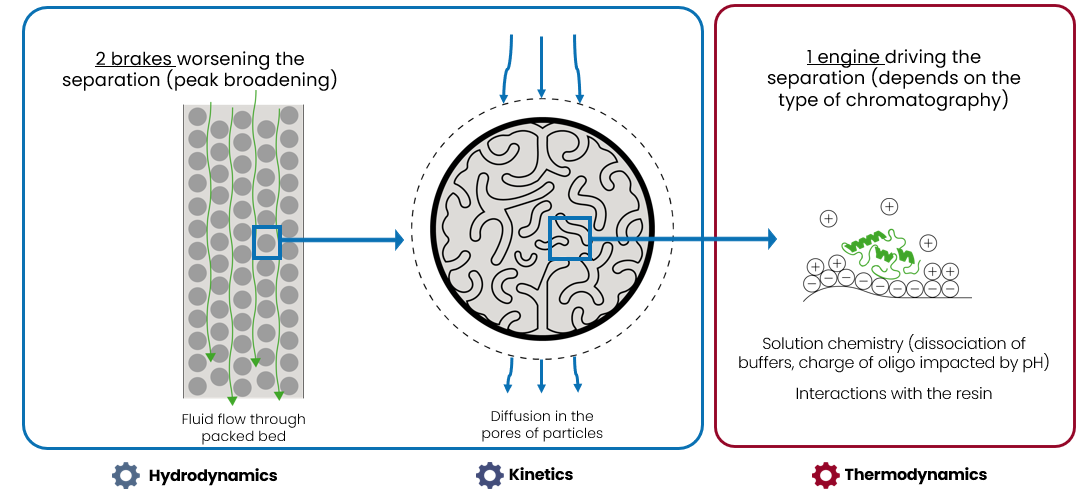
Reaction and transport rates are incorparated in the model to describe the formation, transformation, and consumption of species, particularly from the solution to the chromatographic medium and vice versa. Kinetics is considered one of the two “brake” which can worsen separation.
- Hydrodynamics
Flow, mixing, and mass transfer are explicitly represented to account for spatial heterogeneities and transport limitations. The model links fluid dynamics with species distribution, ensuring realistic scale-up and process design. Hydrodynamics is regarded as the other “brake” that can worsen separation.
- Thermodynamics
This fundamental is embedded at the core of the model capturing the behaviour of species within the solution and how they interact with the chromatographic medium at equilibrium. Thermodynamics is the “engine” driving the separation.
- Solution Chemistry
Ypso-Ionic captures the chemistry occurring in solution. By representing these interactions, the model accurately predicts pH, conductivity, and ionic composition. By adapting these fundamentals to your specific process and chemistry, you can leverage Ypso-Ionic for truly predictive, scenario-ready simulations.
Inside Ionic’s engine: Drivers and brakes of Separation
Discover the buffer preparation tool below
Buffer Preparation Tool
Accurately prepare and optimize your buffers using our advanced Buffer Prep Tool. Eliminate the guessing and estimations, and ensure consistent, reliable and precise buffer quality.
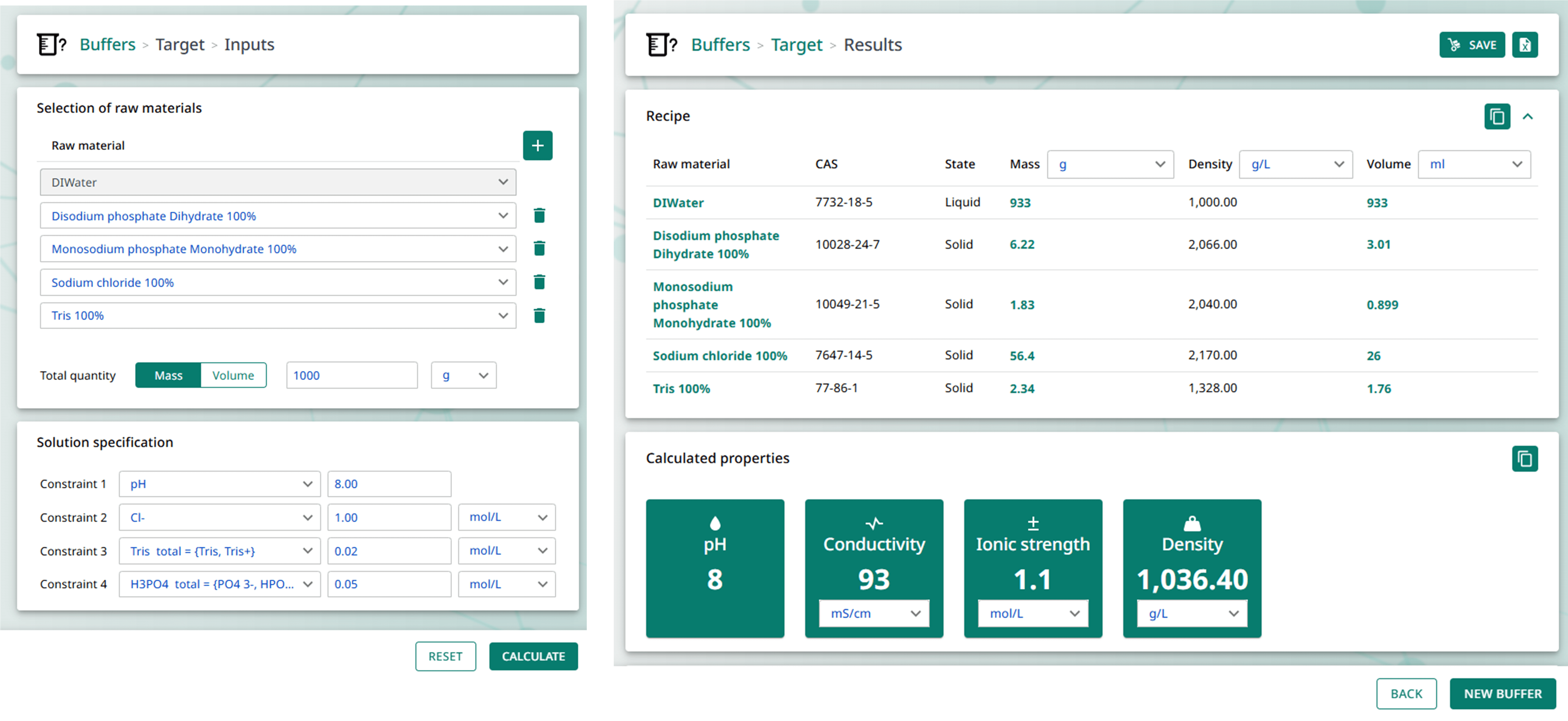
An unlimited number of starting materials can be selected. The tool contains a database with over 50 species and more than 50 common starting materials used for buffer preparation.
The total quantity of buffer solution required can be entered in mass or volume.
Different target constraints can be specified (pH, concentration, conductivity, …).
The tool provides a detailed recipe which can be shared with other people
Summary of calculated properties
Want to know more?
Don't hesitate to contact us!